
US Congresswoman Tulsi Gabbard, newly elected co-chair of the influential Congressional Caucus on India and Indian-Americans, discusses her vision for US-India ties with Rediff.com's Monali Sarkar.
'What we have heard from the Sri Lankans is their desire to have a foreign policy that allows Sri Lanka to best advance its own interests rather than a foreign policy that relied solely on one relationship.' 'We think this is an attitude that makes a lot of sense. India and Sri Lanka have many areas of shared interests, and it's certainly welcomed by us to see that deepening of those ties.'

Modi on the global stage always comes across as a statesman, counselling peace and amity to world leaders even as his policies at home hurt certain sections, explains Virendra Kapoor.

At the summit, India signed the SCO's memorandum of obligations, kick-starting the process of its accession into the group as a full member.

'India alone cannot walk the path of peace. It also has to be Pakistan's journey to make,' says Prime Minister Narendra Modi at the government's geo-political flagship initiative "Raisina Dialogue-II".

'The military aim in a future conflict, if it can't be avoided, should be to cause maximum damage to the adversary's war waging capability and capture limited amount of territory as a bargaining counter,' says Brigadier Gurmeet Kanwal (retd).

Prime Minister Narendra Modi on Tuesday said Australia will not be at the periphery of India's vision but at the centre of its thought, as he called for closer bilateral security cooperation and a comprehensive global strategy to tackle the menace of terrorism.

'If I had not been elected President of the United States, we would right now, in my opinion, be in a major war with North Korea,' Trump said.
There is a sense of relief in Beijing that Modi will be at the helm of affairs in Delhi at a critical juncture in the geopolitics of the region, says Ambassador M K Bhadrakumar.

'The past year has yielded extraordinary results in the strategic, commercial, and people-to-people components of the India-United States partnership, US Ambassador to India Richard Rahul Verma tells Aziz Haniffa/Rediff.com in an exclusive interview.

The two-day summit beginning Sunday will seek to review the progress in ties and deepen strategic dimension of the bilateral relationship.

This is the joint statement issued by the ministry of external affairs on the visit of US President Barack Obama to India.

New Delhi remains a priggish suitor to Washington's overtures, but it has begun appreciating potential tech benefits to ties with the US.

As the pandemic unfolded, the India-China relationship has come under severe stress. To restore normalcy, agreements between the two countries must be respected scrupulously in their entirety. Where the Line of Actual Control is concerned, any attempt to unilaterally change the status quo is unacceptable, declares External Affairs Minister Dr Subrahmanyam Jaishankar.

The US election campaign has provided plenty of ammunition for the CCP to make its case that its political system is superior.

'Open conflict would be a disaster for both China and India.'
'India will come increasingly in the US crosshairs if it insists on maintaining its strategic autonomy, warns Ambassador M K Bhadrakumar.

Joe Biden's B3W proposal aims to bring democracies together. India should come up with its own plans to contribute to the initiative, states Rahul Mishra.

'Modi's promise of change during the election campaign was on the domestic front, but his first year in office focused on foreign policy beyond all expectations,' says Ambassador T P Sreenivasan.

With Donald Trump the appeal has to be to his business instincts in which his personal interests seem to play a significant role, says former foreign secretary Kanwal Sibal.

WH said they are expected to set forth a vision that will expand the bilateral partnership

Tillerson said the US will provide India with best technologies for its military modernisation which include offers to supply F-16 and F-18 fighter jets.

India has declined assistance offered by the United Nations of its integrated supply chain for COVID19-related material, saying the country has a "robust system" to deal with the required logistics, a spokesperson for UN Secretary General Antonio Guterres said.

'What gives hope is that Modi's own leadership is vitally linked to his capacity to deliver on the economic front. Indeed, if he succeeds, India's foreign policies will have changed beyond recognition,' feels Ambassador M K Bhadrakumar.

In a strong message to China, India and ASEAN on Thursday called for a "full and effective" implementation of the understanding between the parties involved in the South China Sea dispute, while stressing on maritime security and freedom of navigation in the critical sea lanes.

'One must remember that a dragon has a forked tongue,' warns Vivek Gumaste.
'Modi's first foreign trip at the very outset of his second term as PM reinforces a growing impression that this regional tour underscores a shift in emphasis in India's foreign policy that was traditionally focused on the northern tier of countries to the Indian Ocean rim,' explains Ambassador M K Bhadrakumar.
Nifty ends above 8,400; TCS, HDFC surge 2%, Bajaj Auto dips 2%.

'Trump's stated strong stance against Islamist extremism and terrorism could play into the Indo-US relationship.' 'It could mould US attitude and exert pressure on Pakistan.' 'In the event of US military presence in Afghanistan increasing, however, Pakistan could gain an opportunity to again emphasise its importance.'
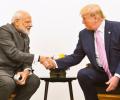
'From the Indian perspective, Trump's invitation to Imran Khan to visit the White House is a bitter pill to swallow,' points out Ambassador M K Bhadrakumar.

10 takeaways from the prime minister's UN speech.

The India-Japan joint naval exercises are a strategic signal for China, observes Dr Rajaram Panda.

'The Indian version is that the two top diplomats merely exchanged pleasantries, while the Pakistani side characterised the encounter as an 'informal dialogue'.' 'The truth, as always in such piquant situations, is somewhere in between.' 'It stands to reason that ice has been broken,' says Ambassador M K Bhadrakumar.

The IAF chief also said Pakistan has become a pawn of Chinese policy and its dependence on China would increase further in future. He said India needs to understand the interplay of some major events in its vicinity that would impact the security scenario of the region.
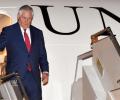
Pakistan Prime Minister Shahid Khaqan Abbasi assured the Secretary of State that his country is committed to the war against terrorism.

Indians at large harbour a notion that their country is cherrypicking out of the American basket of goodies, but the policymakers in Delhi and the political leadership are well aware that it can only be a pipe dream since a military alliance with a superpower is a profound irrevocable commitment, observes Ambassador M K Bhadrakumar.

'The fatal mistake for the USSR was the invasion of Afghanistan.' 'Quite possibly the fatal mistake for the Chinese empire is the assault on Ladakh,' observes Rajeev Srinivasan.

'It is in the interest of both sides that the visit of the US President is seen as being successful. Both sides have invested considerable political capital in it. This rapid exchange of visits and the decisions taken have to be justified, beyond the symbolism, which is no doubt important in itself. This opportunity to impart a fresh momentum to ties should not be missed,' says former foreign secretary Kanwal Sibal.

Describing India as an "emerging democratic superpower", Australian Prime Minister Tony Abbott on Thursday kicked off his two-day India visit during which the two countries are likely to clinch an elusive civil nuclear deal.

Gokhale and Pompeo expressed satisfaction over the significant progress and the quality of the India-US Strategic Partnership
